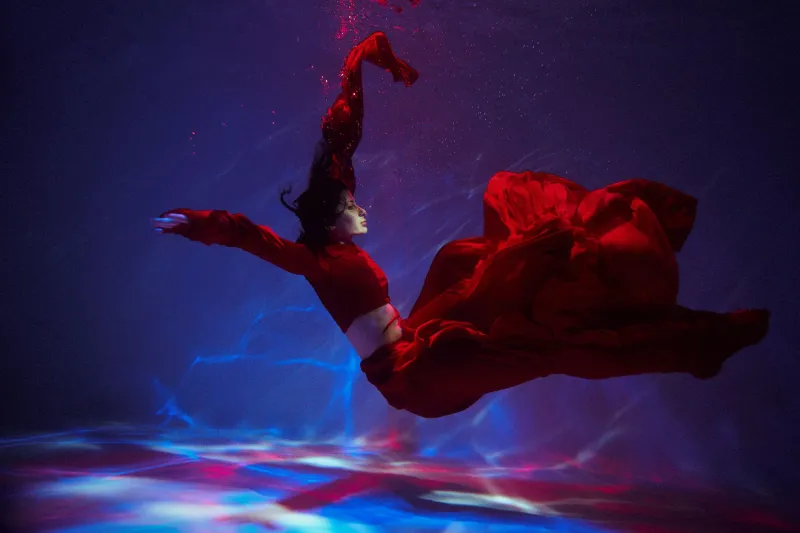
Holding Your Breath Is Not a Pose: Five Underwater Fetish Shoot Myths UK Studios Should Retire

Photo: Unknown photographer from the photography studio of the Imperial Bolshoi Theatre, Moscow, Public domain, via Wikimedia Commons
Breath-holding is one of the most misunderstood elements of underwater glamour and fetish photography. On a well-run set it is a technical and creative tool; on a badly run set it becomes a myth wrapped in bravado. For UK photographers and models working in tanks, pools and purpose-built studios, the difference matters. The following five myths are common, persistent and worth retiring in 2026.
Myth one: The longer the hold, the stronger the image
A long breath-hold looks impressive to the person counting, but the camera rarely rewards duration for its own sake. The strongest underwater frames usually come from a short, well-rehearsed moment: the model enters the water, settles into position, holds for the time needed to capture the shape and expression, then rises. Extra seconds do not automatically add tension. They often add strain, and strain reads on the face and body.
UK tank studios tend to work within fixed depths and limited session times. That is not a disadvantage. It encourages photographers to plan the shot before the model is submerged, to brief the pose above water and to shoot in short bursts. The aim is not endurance. It is control.
Myth two: Models should train their breath-holds on set
A shoot is not a breath-hold training session. Models may have different levels of comfort, different lung capacity and different medical histories. Asking someone to push their limits in a working environment is neither creative nor responsible. Any breath-hold practice should be separate from the shoot, undertaken with appropriate supervision and never treated as a test of professionalism.
For fetish editorial, the model's composure is part of the image. That composure is more likely to appear when the hold is within comfortable limits. A photographer who respects a shorter working breath will get better expressions, more precise poses and a safer set. A photographer who treats the tank as a proving ground will get tension of the wrong kind.
Myth three: Hyperventilation buys extra time
Hyperventilation before a breath-hold is a persistent myth and a dangerous one. It can make a person feel as though they have more time while actually reducing the warning signs that the body needs to breathe. It has no place in a professional underwater shoot. Nor does breath-holding alone, or without a competent spotter, safety diver or venue-approved supervision.
UK studios should have clear procedures for entry, exit, signalling and emergency response. Public pools and specialist tanks may have their own rules, and those rules should be treated as the floor rather than the ceiling. The responsible approach is boring in the best sense: a briefing, a signal check, a shallow first pass and a stop signal that everyone understands.
Myth four: Shallow water is automatically safe
Shallow water changes the risk; it does not remove it. A model can still become distressed, slip, inhale water or struggle to surface in a crowded or poorly supervised tank. Shallow water can also encourage complacency, especially when the pose looks simple. The fact that a shot is only a metre below the surface does not mean it can be improvised.
For UK sets, the venue's risk assessment should be read and understood before the shoot. Access, footing, lighting cables, water clarity and the number of people in the tank all matter. A fetish editorial may involve restraints, fabric, heels or props that behave differently when wet. Those elements need to be checked in the water, not just discussed in the changing room.
Myth five: Editing can rescue a rushed breath-hold
Post-production can adjust colour, contrast and texture. It cannot retrospectively create a safe set or a calm model. If a frame was captured in a moment of panic, the image will usually show it: the jaw, the eyes, the shoulders and the hands tend to tell the truth. Retouching may soften the evidence, but it does not make the process sound.
The better approach is to build the shot around the breath rather than against it. Rehearse the pose on land. Decide where the model will look and how the hands will sit. Keep the first few takes short. Review the frames while the model is out of the water. Then repeat only what is necessary. This is slower, but it produces the kind of controlled atmosphere that distinguishes specialist underwater editorial from novelty imagery.
A reality check for UK studios
The UK adult market rewards distinctiveness, but it also rewards professionalism. Underwater glamour and fetish photography sit at the intersection of technical craft and adult editorial, and breath-holding is where that intersection becomes most visible. The myths above tend to flourish when sets are rushed, when roles are unclear or when enthusiasm outpaces planning.
A responsible set does not have to be a dull one. It can be atmospheric, explicit in intent and visually ambitious. But it should be built on clear consent, competent supervision and a shared understanding that the breath is not a stunt. In 2026, the most credible underwater editorials are likely to be the ones that treat safety as part of the aesthetic: calm, deliberate and controlled. That is a better signature for Underwater Girl than any amount of bravado.