The Face That Returns: Makeup Continuity for UK Underwater Editorial in 2026
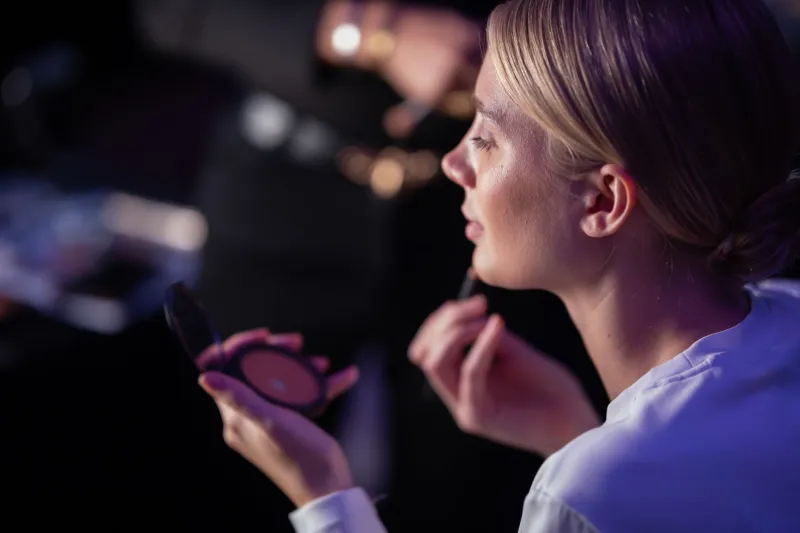
Underwater editorial makeup is often discussed as a styling question. In practice, it is a continuity and safety question. A look that photographs beautifully in the first minute but leaves a performer with stinging eyes, patchy brows or a clouded pool has failed the set. In UK underwater glamour and fetish work, where small crews and hired pools demand efficiency, the makeup plan should be as rehearsed as the breath plan. The aim is not to make cosmetics invincible. It is to build a repeatable system that protects skin, preserves editorial intent and keeps the water free of loose particles.
Begin with the water, not the palette
Before a single product is chosen, confirm the water type and the venue rules. A council-run pool, a private chlorinated tank and a salt-water system behave differently. Chlorine can strip oils and leave skin tight; salt water can draw moisture and encourage product to migrate; hard-water areas can leave a film that makes foundation look uneven. Ask the venue about chlorine or salt levels, pH, temperature, filtration and any restrictions on cosmetics. These questions belong in the same planning document as call times and shot lists.
Patch testing should happen at least twenty-four to forty-eight hours before the shoot, on the inner forearm and, where relevant, behind the ear. A patch test is a sensible precaution rather than a guarantee, and any performer with known sensitivities should follow their own clinician's advice. In 2026, UK editorial teams should also record which products were tested, not simply confirm that a test took place. That record supports future bookings and makes a second shoot less speculative.
Build a short, water-aware kit
Waterproof labelling is not a guarantee. Water-resistant, transfer-resistant and long-wear claims describe degrees of behaviour, not absolutes. A workable kit for underwater editorial tends to be short: a silicone-based primer where the performer's skin tolerates it, a transfer-resistant base, cream or pressed eyeshadow, waterproof mascara, smudge-resistant gel liner, a long-wear lip stain and a brow product that sets without flaking. Pressed pigments and creams are easier to control than loose powders, which can drift, clump and cloud water.
Cosmetic sealants and setting products should be used only after patch testing and within manufacturer guidance. More product is not automatically more secure. A thin, layered application usually behaves better than a heavy one, because thick product can crease, slide or lift as soon as the face is immersed. The kit should also include a dry towel, cotton buds, blotting papers and a small mirror kept away from the water's edge. The best continuity tool is often restraint.
Choose finishes that look deliberate
Underwater light is unforgiving. It exaggerates texture, catches every fleck and makes a small smear look like a major event. Finishes that read as intentional glamour tend to be controlled rather than highly reflective: satin skin, a defined brow, graphic liner, a block colour on the lid or a stain on the lip. Heavy matte foundation can read chalky beneath water, while high-shimmer products can scatter and look like debris. A cream contour is usually easier to maintain than a powder contour, and a stain is more reliable than a gloss that may emulsify or cloud.
The editorial aim is not to pretend that water has no effect. It is to make the effect look chosen. A softened lip edge or a slightly diffused liner can be part of the look if it is consistent between frames. What undermines an image is irregularity: one eye holding, the other migrating; a brow half gone; a patch of foundation that has separated while the rest of the face remains intact. Test the full look in a clean bucket or sink before the shoot, photograph it wet and dry, and compare the two. That simple rehearsal reveals more than a dozen product claims.
Plan continuity between takes
Continuity is a schedule issue as much as a makeup issue. Photograph the finished face under the intended lighting. Note the order of products and the approximate time spent in water. Keep a small dry touch-up station away from the pool edge, with a duplicate lip product and liner in case the original is dropped or contaminated. Between immersions, pat the face dry rather than rubbing it. Use a cotton bud and a tiny amount of cream product to correct one area at a time, then re-seal only where needed. Over-layering is the most common cause of sudden failure.
The performer should be warm, comfortable and able to stop at any point. Makeup continuity should never override breath comfort or skin sensation. If a product begins to sting, drift into the eyes or feel tight, the correct response is to pause and remove it, not to push through for one more frame. A formal continuity plan includes a removal step and a neutral baseline look, so the shoot can continue safely if a product has to be abandoned.
Keep particles out of the pool
Glitter, loose shimmer, sequins, flocking and hairspray are poor guests in any shared water space. They can shed, float and clog filtration, and they complicate the venue relationship that UK underwater editorial depends on. Use pressed or cream products, avoid loose powder near the water, and never shake brushes over the pool. Remove makeup away from the water's edge and dispose of wipes and cotton buds in a closed bin. Check the venue's rules before the day, because a product that seems harmless on a face can be a filtration problem in volume.
Aftercare and the written record
Removal should be gentle: an oil-based cleanser followed by a mild cleanser, according to the performer's usual routine. Record the products used, batch numbers where available, water type, approximate immersion time and any reaction. This is not bureaucracy for its own sake. It is how a UK studio builds a reliable makeup plan for 2026 and beyond, and how it shows performers that continuity is being managed with care rather than improvisation.
The face that returns between takes is the result of preparation, not luck. Start with the water, keep the kit short, choose controlled finishes, rehearse the touch-up and protect the pool from particles. Underwater glamour can be atmospheric and explicit in intent without becoming messy in practice. The makeup plan is part of the editorial craft.