Keepers of the Pool: A Privacy Framework for Venue Staff on UK Underwater Adult Shoots
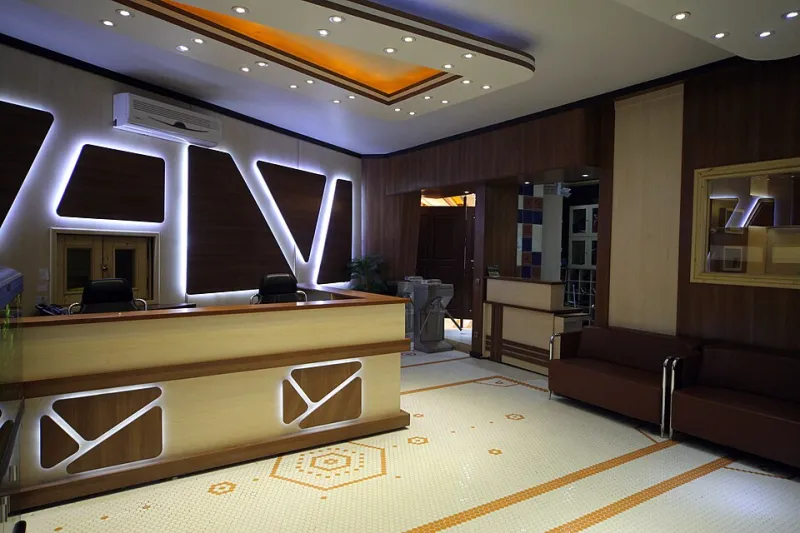
Photo: Ghasem javadi, CC BY-SA 4.0, via Wikimedia Commons
An underwater adult set is usually described in terms of the people in the water: the performer, the photographer, the safety diver, the lighting assistant balanced on the poolside. Yet the ordinary operation of a UK pool or tank depends on another group entirely — the lifeguard on rotation, the attendant at the reception desk, the cleaner working the changing rooms, the venue manager who holds the keys. They are not crew. They have not been cast. But they are present, and their presence shapes what can be photographed, who can see it, and how comfortably the adult intent of the shoot can be maintained. A privacy plan for the dry side is therefore not a courtesy. It is part of the production's duty of care.
The dry side is a working environment
UK venues are entitled to keep their buildings running. A pool cannot usually be handed over in total isolation; health and safety obligations, insurance conditions and local authority rules often require a qualified lifeguard to remain on site throughout any session involving water. Cleaning and maintenance may continue in adjacent areas. A manager may need to inspect plant rooms or answer calls. Producers who plan for an empty venue and arrive to find a rota of staff are already on the back foot.
The practical starting point is to accept that the dry side has its own operating rhythm. Ask the venue, before contracts are signed, who will be on site during the booked hours, where their duties take them, and which doors, corridors and windows look onto the water. This is not intrusive; it is the same information a film crew would request for any location. For an adult production, however, the answers carry additional weight. The goal is not to conceal the shoot but to control incidental exposure — the unplanned glance, the phone held at the wrong angle, the cleaner entering a room that has become a temporary changing area.
Sightlines before signatures
Privacy on an underwater set is often discussed in terms of curtains and closed doors. In practice, it is a question of sightlines. A lifeguard stationed at the deep end may have a clear view of the water but no view of the monitor. A reception desk may face a corridor that leads to the pool hall. A first-floor office window may overlook the shallow end. Each of these is manageable, but only if it is known in advance.
A useful exercise is to walk the venue as a camera would: from the water's edge outward. Note every point from which the set, the performers or the monitors can be seen. Then agree with the venue manager which of those points need temporary screening, which need a staff briefing, and which are acceptable because the staff member in question is bound by the venue's own confidentiality policy. Where screening is used, it should not obstruct lifeguards' sightlines to the water. A privacy screen that compromises safety is not a solution.
Producers should also consider what is visible on monitors and laptops. A dry-side witness does not need to see a live feed of explicit material in order to do their job. Positioning review screens away from thoroughfares and reception areas is a simple measure that respects both the performer and the staff member.
Brief the role, not just the rulebook
Confidentiality agreements have their place, but they are not a substitute for a briefing. A lifeguard who is handed a two-page non-disclosure agreement without context may sign it and still feel uncertain about what they are supposed to do if a colleague wanders in, or if they are asked a question by a member of the public. The briefing should be short, plain and role-specific.
For a lifeguard, the key points are their safety authority, their position, and their discretion. They need to know that the production recognises their professional judgement overrides any creative request. For an attendant or cleaner, the key points are access windows and the location of any off-limits areas. For a venue manager, the key points are the chain of command and the arrangements for signing in visitors.
Where a confidentiality undertaking is used, it should be proportionate. It should explain that the production is adult in nature, that performers' privacy is paramount, and that staff should not photograph, record or describe the session outside their duties. It should also make clear what staff should do if they have a concern — not simply warn them against speaking. A short, signed record that the briefing took place is more useful than a lengthy document no one has read.
Access windows and the closed-set illusion
Many adult productions describe themselves as closed sets. In a UK pool, that description is rarely absolute. A closed set can mean that no one enters the pool hall without the producer's knowledge; it cannot mean that the venue abandons its legal duties. The honest approach is to define access windows rather than pretend there are none.
For example, cleaning staff might be scheduled to finish before the first submersion and return only after the final towel. A manager might agree to conduct any necessary inspection at a pre-arranged break. A lifeguard might be positioned at a station that has been agreed with the producer and the venue. These arrangements should be written into the call sheet and repeated at the briefing. They should also be flexible enough to accommodate an emergency; no access window should ever delay a safety response.
Signage helps. A simple notice at the pool hall entrance — 'Closed production in progress; please report to reception' — is not an admission of anything unusual. It is a standard location-management tool. Combined with a named contact, it gives staff a clear route if they need access.
A chain of command that the venue recognises
On the dry side, ambiguity is the enemy of privacy. Staff need to know who speaks for the production. That person should be named on the call sheet and introduced at the briefing. They should be reachable throughout the session. If the producer is in the water or behind the camera, a runner or production assistant should hold the dry-side contact role.
The chain should also respect the venue's own hierarchy. A lifeguard takes safety direction from the venue's senior lifeguard, not from the photographer. A cleaner takes task direction from their supervisor. The production's dry-side contact coordinates with those people; they do not override them. Where a decision affects both safety and creative intent, the safer option should prevail, and the production should be prepared to pause rather than negotiate in the moment.
What staff should never be asked to do
Venue staff are not a free production crew. They should not be asked to hold reflectors, fetch props from changing areas, monitor a performer's body, or stand guard at a door without prior agreement and appropriate briefing. Nor should they be asked to sign away rights they do not understand. Where a staff member appears incidentally in a frame, the production should have a clear policy: either the frame is not used, or the person's consent is sought separately and specifically. Adult editorial depends on consent that is informed, not inferred from a contract of employment with a swimming pool.
After the last towel
Privacy does not end when the cameras stop. A short debrief with the venue's duty manager is worthwhile: confirm that no unauthorised images were taken, thank staff for their discretion, and leave a single point of contact for any follow-up. If the production has agreed to provide a summary of the session for the venue's records, do so promptly. Discretion is easier to maintain when staff feel respected rather than policed.
The people above the waterline are not extras in an underwater shoot. They are the reason the water is there at all. A privacy framework that treats them as professionals — briefed, named, and given clear boundaries — protects the performer, the venue and the production in equal measure. In a niche as intimate as UK underwater adult editorial, that kind of dry-side care is not administration. It is craft.