Hands That Speak: A Working Consent Vocabulary for UK Underwater Adult Sets
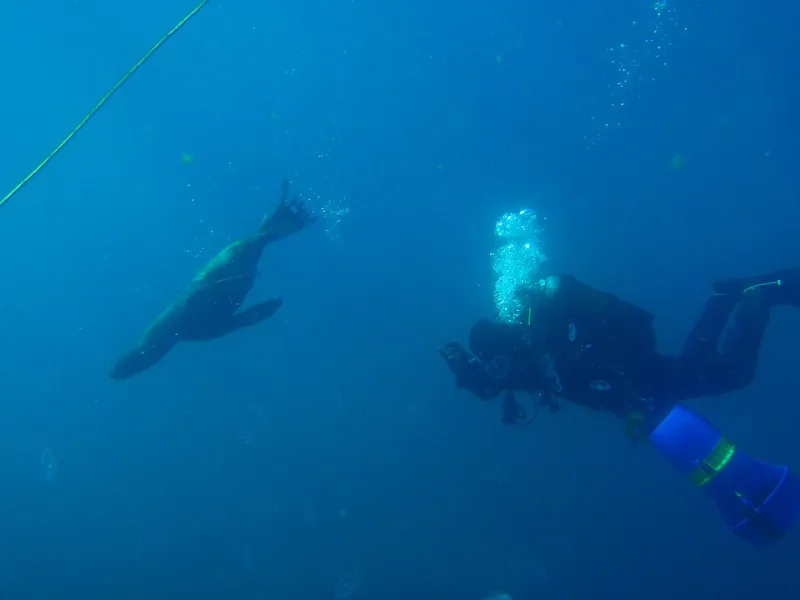
Photo: Peter Southwood, CC BY-SA 3.0, via Wikimedia Commons
Underwater adult editorial asks performers to do something that runs against ordinary conversation: communicate while unable to speak. A director may be six feet away at the poolside, a safety diver may be behind the camera, and a fetish rig may limit the use of a hand. Consent does not disappear in those conditions, but it does need a working language. For UK producers, the responsible approach is not to assume that a thumbs-up or a tap will carry the necessary meaning. It is to design a non-verbal consent lexicon, rehearse it before the first descent, document it in the shoot file, and treat any missed signal as a systems problem rather than a performer's failure.
Begin with a shared vocabulary, not a gesture list
A consent lexicon is more than a collection of hand shapes. It is an agreement about what each signal means, who is responsible for watching for it, and what happens next. Before the shoot, the producer, director, safety diver and performer should agree on a small set of primary signals and a smaller set of escalation signals. The lexicon should be written down in plain English and included in the call sheet or consent annex. It should also be explained aloud in the dry briefing, because a document that nobody has practised is not a communication system.
The core vocabulary should cover four ideas: I am well; I need a moment; I need to surface now; and stop the scene. In UK pools and tanks, where visibility and surface noise vary, these ideas should have both a visual and a tactile version where possible. A performer who cannot raise a hand because of a rig may still be able to tap a fixed surface or squeeze a safety diver's forearm. The lexicon should therefore include at least one channel that does not depend on full limb movement.
The core signals and the ambiguous middle
A clear "I am well" signal is useful but should not be treated as a substitute for active checking. A performer may be holding position, managing a wardrobe issue or concentrating on a breath, and may not think to signal wellbeing unprompted. The safety diver or director should own regular check-ins, using a pre-agreed visual prompt and expecting a specific response. If the response is absent, the default should be to bring the performer to the surface, not to wait for a more dramatic signal.
"I need a moment" is the most easily blurred signal. It can mean the performer is adjusting, uncomfortable, or approaching the limit of a hold. For that reason, producers should define a maximum response time. If the performer gives the pause signal, the scene stops moving; the safety diver acknowledges; and the performer either resolves the issue within an agreed window or surfaces. The lexicon should not leave a performer in an ambiguous middle where everyone can see a gesture but nobody knows whether to intervene.
"Surface now" should be unambiguous and should override every other instruction. It should be demonstrated in the dry briefing and practised in the water at the start of the session. The stop signal should be equally clear and should apply to the whole scene, not only to the performer. A director who sees the signal should call the stop aloud at the surface, so that camera operators, lighting assistants and other crew also cease work.
Tap codes and tactile channels
Tap codes are valuable in underwater fetish editorial because they can survive restricted movement, low light and close camera framing. A simple system is usually better than an elaborate one: one tap for acknowledgement, two for pause, three for surface. The code should be agreed with the individual performer, not imposed generically, and it should be tested on land and then in shallow water before it is relied on in a held-breath scene.
The tactile channel also needs a named receiver. If the safety diver is the person holding the performer's hand or forearm, then the safety diver is responsible for acknowledging taps and relaying the meaning to the director. That relay should be rehearsed. In a busy pool with reflected sound and several crew members, a nod may not be enough. A short spoken call at the surface — "two taps, pause" — keeps the whole team aligned.
Check-ins that do not rely on the performer initiating
Good consent practice underwater is not only about giving the performer a way to say stop. It is also about building routine check-ins that do not depend on the performer's initiative. These can be visual: a fixed hand shape returned to camera, a thumbs-up held for a beat, or a deliberate blink pattern agreed in advance. They can be positional: the performer returns to a marked spot at the tank wall after each setup. They can be time-based: the safety diver signals a check at agreed intervals, and the performer responds.
For UK sets, where pool hire time is often tight, the temptation is to compress these check-ins into the first setup and then let them lapse. Producers should resist that. A brief check-in between takes costs seconds; an unmanaged distress event costs far more, both in human terms and in professional reputation.
Rehearse before the first descent
The dry rehearsal is where the lexicon becomes usable. The performer, safety diver and director should run through each signal on poolside, then in shallow water, then in the actual shooting position if conditions allow. The rehearsal should include a deliberately missed signal. The safety diver should not respond to one prompt, and the team should observe what happens: does the director notice, does the camera operator keep rolling, does anyone call the stop? This is not a test of the performer. It is a test of the system.
A useful rehearsal also covers the awkward cases: a performer whose hands are restrained by a rig; a performer wearing a mask that obscures eye expression; a performer positioned behind a prop that hides one arm. The lexicon should be adjusted until every performer has at least two reliable ways to communicate the four core ideas.
Document the lexicon in the consent annex
The written record should include the signals, their meanings, the named receiver for each channel, the maximum response time for a pause, and the agreed procedure if a signal is missed. It should be signed or otherwise acknowledged by the performer and the safety diver, and it should sit alongside the risk assessment and the pool's own rules. In UK adult production, where insurers and venues may ask for evidence of safe systems of work, this annex is not bureaucracy. It is the paper trail that shows consent was actively designed rather than assumed.
The annex should also record any performer-specific adaptations. If a rig prevents a hand signal, the alternative should be written down. If a performer prefers a different tap code, that preference should be recorded. Consent is personal, and the lexicon should reflect the person using it.
When a signal is missed
A missed signal should trigger an immediate surface and a calm debrief. The first priority is the performer's wellbeing; the second is understanding why the system failed. Was the signal outside the camera operator's line of sight? Was the safety diver positioned too far away? Was the rehearsal too brief? Was the signal itself ambiguous? The answer should lead to a change in the lexicon, the positioning or the crew roles before the next submersion.
Blame is not a safety tool. A performer who has to repeat a signal is not being difficult; they are exposing a gap in the system. Producers should thank them for using the signal and then fix the gap. That response encourages early communication, which is exactly what a non-verbal lexicon is for.
Adapting the lexicon for rigs, props and held-breath work
Rigs and props can obscure hands, restrict wrists and change buoyancy. The lexicon should be tested with the actual equipment, not with a theoretical body. If a prop occupies both hands, the performer needs a foot tap, a head movement or a tactile channel. If a rig holds the arms, the safety diver should establish a physical contact point before the hold begins. If a hood or mask limits peripheral vision, the check-in should come from the front or from a pre-agreed side.
Held-breath work deserves particular care. The lexicon should include a pre-hold confirmation, a mid-hold check-in where appropriate, and an unambiguous surface signal. The performer should never be expected to hold through a pause signal in order to preserve a take. The scene can be rebuilt; the performer's trust cannot.
Close the loop after the shoot
A short review at the end of the day will improve the next one. Ask the performer which signals felt natural, which were hard to use, and whether any check-in felt intrusive or too late. Ask the safety diver whether the sight lines worked. Ask the director whether the lexicon interfered with the editorial intention. The answers should be recorded and carried forward.
Underwater adult editorial can be atmospheric, specialised and visually ambitious. None of that requires consent to become vague. A clear non-verbal lexicon gives performers a reliable way to say stop, pause or surface without speech, and it gives UK producers a defensible, humane system that holds up when the water makes ordinary conversation impossible.