The Meniscus Contract: Shot-Listing the Over-Under Frame on UK Underwater Sets

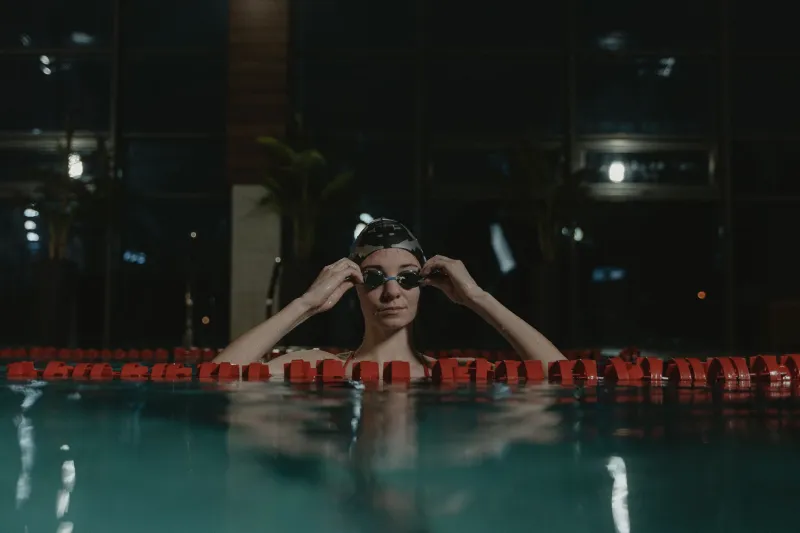
The over-under frame is one of the most recognisable images in underwater glamour: a single picture in which the surface becomes a horizon, the body is divided between air and water, and the viewer is asked to hold two environments at once. In UK underwater fetish and glamour editorial it is more than a clever composition. It states the premise. It says that the set is neither fully dry nor fully submerged, and that the tension between those states is the point.
Yet the split-level frame is routinely treated as a bonus. It is added to the end of a shot list, attempted after the water has been disturbed, and abandoned when the light or the hair will not cooperate. That is a mistake of planning rather than craft. The waterline deserves its own line on the call sheet, its own time allocation and its own safety conversation.
A shot category, not a party trick
The over-under image behaves differently from every other frame on a UK underwater set. Its exposure is split between two media. Its focus is split between two refractive spaces. Its continuity is split between dry hair above the surface and wet hair below it. Even the talent's breathing changes, because the pose often asks for a half-submerged face and a held breath at the surface.
For that reason, the waterline should be scheduled as a distinct unit. Twenty to thirty minutes is a sensible minimum for a single performer, before any wardrobe changes. That time covers calibration, a settling period after entry, the hero frames and the repeats. It is not dead time. It is the difference between a frame that looks deliberate and one that looks like an accident with a dome port.
The physics of the seam
The waterline is not a straight line. It is a meniscus, a curve created by surface tension where water meets skin, fabric or latex. The curve pulls upward against the body and can be thicker or thinner depending on what is on the skin. Oils, lotions and some makeup removers alter surface tension and leave a scum ring at the seam. That ring is visible in close focus, and it is difficult to retouch honestly.
Water clarity matters as much as the lens. A still surface reads cleanly; a surface with ripples, bubbles or floating debris breaks the line into fragments. The practical response is patience. After a performer enters the water, allow the surface to settle. Keep inlet jets away from the shooting mark. Ask the venue to confirm that no filtration backwash, wave machine or other pool user will disturb the water during the slot.
The camera position is equally sensitive. With a dome port, a small change in height shifts the split dramatically. The waterline may sit at the eyes in one frame and at the collarbone in the next. A floating marker or a fixed reference point at the pool edge helps the photographer return to the same height. A calibration frame, with a grey card and a small ruler held half in and half out of the water, gives the post-production team a reference for colour and for the true waterline.
Balancing two exposures
The over-under frame fails most often at the lighting stage. Above the surface, ambient light may be bright and directional. Below the surface, light falls away quickly and takes on the colour of the water. The two halves must be balanced deliberately, not left to the camera's meter.
A workable approach is to establish the below-water exposure first, then feather the above-water sources until the surface reflection and the dry half of the body sit within a stop or so of the submerged half. Above-water strobes should be flagged to control flare on the waterline. Below-water lights should be on dimmers, because the difference between a clean fill and a blown highlight is often a small turn of a dial. Colour temperature also needs attention: UK pool water can read green or cyan, while above-water daylight may be cooler. A white balance reference taken in both halves of the frame is more useful than guesswork.
For fetish wardrobe, the waterline creates a second problem: specular highlights. Latex, PVC and wet-look fabrics reflect above-water sources sharply at the seam. The solution is not to remove the highlights but to place them where they describe the material rather than flare into the lens. Small flags, black cards and a careful choice of source size do more than heavy retouching.
Hair, makeup and wardrobe at the seam
The waterline is unkind to continuity. Dry hair above the surface can look stiff and separated; wet hair below it clings and darkens. Wigs and hairpieces need secure anchors that survive chlorinated water without damaging the lace or the skin. Adhesives should be tested in advance, not at the pool edge. A hair stylist working at the waterline should have a spray bottle of fresh water, a wide-tooth comb and a towel within reach, and should avoid introducing conditioner into the pool, where it affects filtration and surface tension.
Makeup behaves in a similar way. Products migrate at the seam. Oil-based formulas can create a slick that shows as a rainbow film on the water and a scum line on the skin. Waterproof mascara and setting products help, but they must be tested for flaking as well as smudging. The makeup artist should work in thin layers, seal the waterline area, and keep cotton buds and micellar water at the poolside for repairs between frames. For adult editorial, the face is often the emotional centre of the frame, so a two-minute reset at the edge is worth more than ten minutes of retouching later.
Briefing the venue
UK pools and private tanks vary enormously in what they can support. A leisure trust pool hired for a private session may have excellent water clarity but no blackout and a strict lifeguard requirement. A private studio tank may offer controlled lighting and a still surface but limited changing space. The briefing should establish the shooting mark, water depth, water temperature, chlorine and pH logs, filtration schedule, ceiling height, power availability and poolside access. Non-slip matting, a dry changing area and a warm recovery space are not luxuries on a UK shoot.
It is also worth asking for a still-water window. The over-under frame depends on a calm surface, and a slot immediately after a busy public session or a backwash cycle is rarely ideal. A short site visit or video walk-through before the shoot will reveal whether the waterline can be held steady and whether the above-water lighting positions are physically possible.
A repeatable shot list
A practical waterline list might begin with the calibration frame, then move to a hero over-under portrait with the eyes at the seam, a study of hands crossing the surface, a submerged torso with the face above water, a reflection frame, a fabric or latex detail breaking the waterline, a prop crossing the surface, and a backlit silhouette split. The order matters. Shoot the most demanding frames first, while the water is still, and keep a continuity log of waterline height on the body, hair placement and wardrobe position.
Repeat frames require discipline. Allow the surface to settle between attempts. Avoid repeated full submersions to reset the hair; use the poolside mirror and spray bottle instead. Keep one person responsible for watching the waterline and calling the reset.
Safety at the seam
The half-submerged pose can look serene, but it is not a relaxed breathing position. A performer holding the face at the surface while the body is submerged may be holding breath without the usual cues. Brief the breath plan before entry, agree hand signals, keep a safety diver in the water and within arm's reach, and never allow hyperventilation or weighted breath-holds without specialist supervision. Chlorine exposure to eyes and skin should be managed with fresh water rinses and a warm recovery period after the set.
Above all, the waterline frame should be planned as part of the editorial argument, not as an afterthought. When the seam is treated with the same care as the lighting, the wardrobe and the safety plan, it stops being a trick and becomes a signature. In 2026, with UK underwater editorial becoming more technically ambitious, that contract between two environments is worth writing into the schedule from the start.